Our Commitment to Environmental Stewardship:
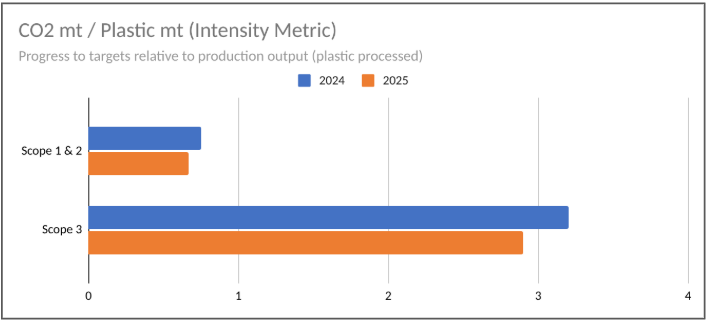
We believe that continuous improvement and environmental responsibility are inseparable. To honor this commitment, we calculate our organizational carbon footprint in strict accordance with the Greenhouse Gas Protocol, accounting for the full life cycle of our products—from raw material extraction to product end-of-life. Our data analysis revealed that the most significant portion of our carbon footprint resides within our supply chain. Consequently, we have identified material innovation as our most impactful lever for driving large-scale emissions reductions.
Driving a Circular Economy:
A cornerstone of our strategy is the integration of post-industrial and ocean-bound resins. Through strategic partnerships with our customers and suppliers, these material innovations allowed us to avoid an estimated 2000 metric tons of CO2e in 2025 alone. Beyond materials, we prioritize circularity through reusable packaging and logistical optimizations that reduce our supply chain’s footprint. These circularity successes provide the foundation for our long-term climate goals.
To ensure our progress remains aligned with global climate science, we have formalized our path forward. We are proud to announce that our emissions reduction targets have been validated by the Science Based Targets initiative (SBTi) as being aligned with the 1.5°C scenario, the most ambitious goal of the Paris Agreement. Our official commitments can be viewed on the SBTi dashboard linked here: SBTi Target Dashboard.